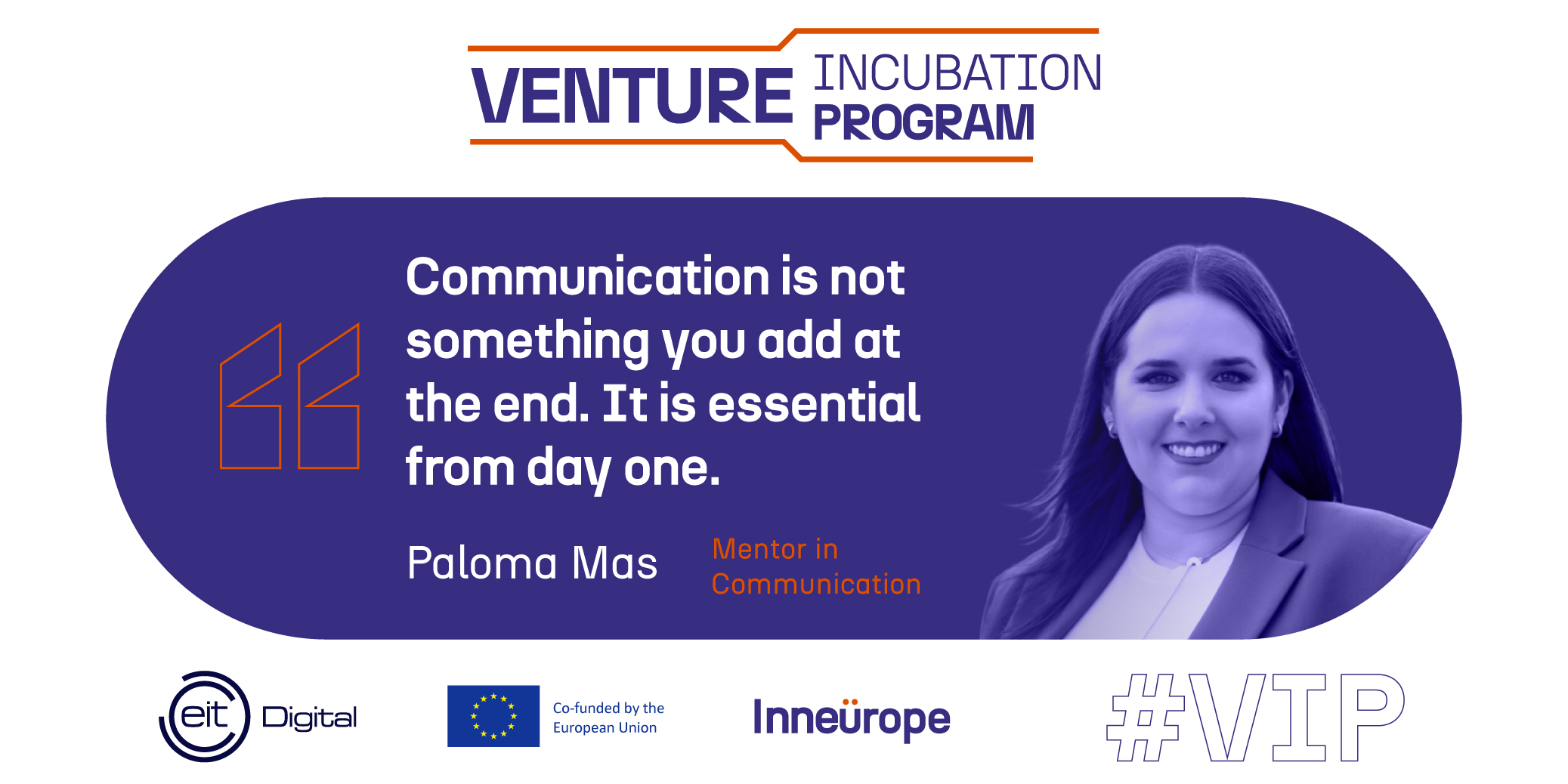
Communication is one of the most decisive challenges for any startup. It’s not just about having a great product or an attractive market: if founders can’t clearly convey what they do, why it matters, and how they stand out, it will be very difficult to attract investment, customers, or talent. As Paloma Mas puts it: “Communication is not something you add at the end. It is essential from day one.”
Within the Venture Incubation Program, this was the focus of Module 8, dedicated to Strategic Communication for Startups and led by Paloma Mas, an expert in communication, investment, and founder advisory. With years of experience in media, innovation, and technology, Paloma has supported founders in accelerators, funds, and corporate initiatives to refine their message and amplify their impact.
The session revolved around three main objectives: helping teams build a clear and compelling narrative, design pitch decks tailored to different audiences (investors, accelerators, or clients), and improve their storytelling techniques as well as their handling of Q&A.
Strategic communication from the start
Communication isn’t optional — it’s the foundation of visibility. Paloma reminded us that the moment a founder shares their idea with a friend, they are already communicating. That’s why a clear strategy is essential, with different layers of messaging: one that anyone can understand, one tailored to industry experts, and one specifically crafted for target clients.
Quick tips:
- Define a simple, clear message anyone can understand.
- Adapt your pitch to each audience: investors, clients, or researchers.
- Keep your value proposition as the anchor of your communication.
The pitch deck: your calling card
The heart of the session was the pitch deck — that short, visual presentation meant to explain, convince, and spark conversation. Paloma outlined its ideal structure: a strong cover, the problem, the solution, the market, the business model, traction, roadmap, team, and funding ask.
Quick tips:
- Keep it visual and consistent; avoid heavy text.
- Be honest but optimistic: show what your product can become.
- Highlight your strongest metrics — they’re your best attractor.
Storytelling and the elevator pitch
Numbers matter, but stories stick. A pitch becomes far more memorable when it includes a real human story — from the founder, a customer, or the vision itself. Paloma also stressed the power of the elevator pitch: a 30–60 second version that captures who you are, what you do, and what you need.
Quick tips:
- Use a simple narrative arc: setup, conflict, and resolution.
- Craft and rehearse your elevator pitch until it feels natural.
- Apply the “two insights rule”: decide which two things you want people to remember about you.
Final reflection
This session was the perfect way to close our learning modules. Communication is the bridge between a good idea and a project that attracts investors, customers, and allies. As Paloma reminded us, success comes not only from building a great product, but from knowing how to tell its story clearly, convincingly, and memorably.