Why Funding is Critical for Startups in Europe
The numbers are clear: 8 out of 10 startups in Europe don’t survive beyond 2.5 years. The main reasons are lack of early-stage funding and the difficulty of scaling beyond their local markets.
So the key question is: how can founders make the most of both public and private funding opportunities to build resilience and growth?
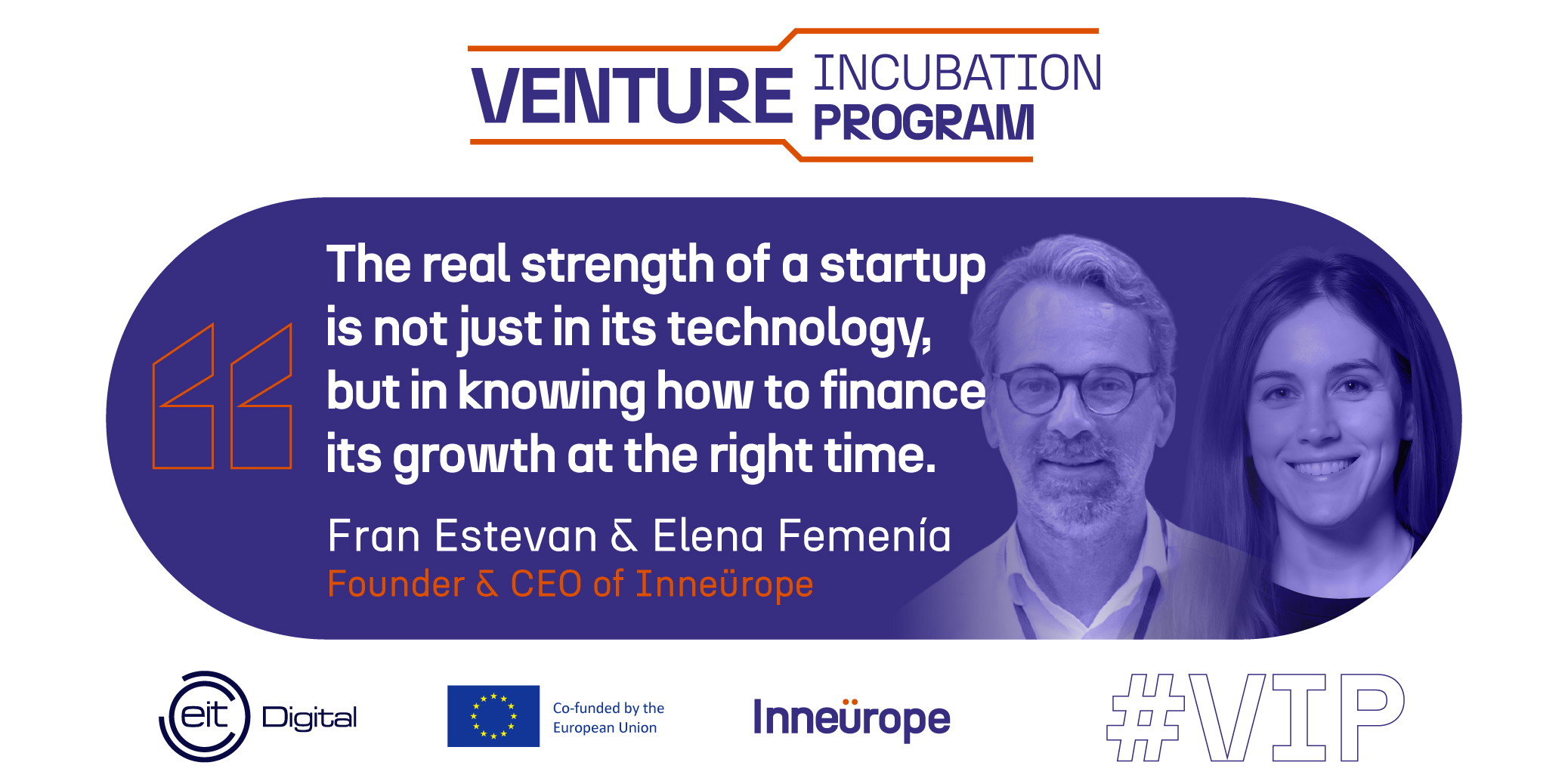
This topic was at the heart of the Venture Incubation Program session on innovation funding, where Elena Femenía, CEO of Inneurope, and Fran Estevan, Founder of Inneurope, shared practical insights for accessing the right funding at the right time.
Public Funding: EU Programs Driving Innovation
EU funds are not just for large corporations. When leveraged well, they are a powerful tool for startups to finance development, validate technology, and gain international credibility.
The European Union works on seven-year budget cycles (currently 2021–2027), with programs ranging from early research to full market deployment.
Key Programs for Startups
- Horizon Europe → the largest R&D program, focused on international consortia.
- EIC Pathfinder & Accelerator → supports disruptive technologies, from proof of concept to market scale; up to €2.5M in grants and €15M in equity.
- Cascade Funding → fast, accessible calls with short applications and funding ranging between €30k and =100k.
- Eurostars → collaborative R&D projects between at least two countries, with a focus on commercialization.
- EIT (European Institute of Innovation & Technology) → sector-specific support (digital, health, energy…) combining funding with incubation and acceleration.
As Elena Femenía highlighted:
“The challenge is not the lack of opportunities, but identifying the right call and translating your project into the language of funders.”
Private Funding: What Investors Are Looking For
On the other side of the spectrum is private capitalfinancing. From business angels to venture capital, these are the players that enable startups to scale quickly and enter new markets.
But the logic has shifted: investors today care less about the technology itself and more about the team, vision, and execution capacity.
Main Types of Private Funding
- Friends, Family & Fools (FFF): first trust-based checks.
- Business Angels: capital plus mentoring and networking.
- Venture Capital (VC) & Corporate VC: larger investments once traction and scalability are proven.
- Equity Crowdfunding: fast capital and social validation.
- Bank loans with public guarantees: an option to grow without equity dilution.
The Three Metrics Every Investor Checks
As Fran Estevan explained, there are three non-negotiable indicators for any startup pitch:
- CAC (Customer Acquisition Cost): how much it costs to acquire a new client.
- LTV (Lifetime Value): the total revenue a client generates over time.
- Cash Runway: how many months of operation remain with current cash.
The golden rule: LTV ≥ 3 × CAC and a runway of at least 6 months.
Fran made it clear:
“Investors often bet more on people than on technology. An idea can evolve, but a solid team makes the difference.”

The Hybrid Strategy: Combining EU Funds and Private Investment
The most resilient startups don’t choose between public or private funding — they combine both.
- Public funding helps reduce risks, validate technology, and increase credibility.
- Private funding accelerates market entry and scaling.
This dual strategy provides the two most valuable assets for a founder: time to execute and trust from investors, who value highlyhighly value when a startup has already been selected in competitive EU programs.
Conclusions: Practical Takeaways for Founders
Funding is more than a resource: it’s a growth strategy. And before raising capital, every founder should answer three essential questions:
- How much do I need?
- What will I use it for?
- What will I achieve with it?
Clarity on these three points often defines the future of a startup. Because in innovation, building is not enough, you also need to know how to finance the journey.
Want to know how your startup can take advantage of these opportunities? Let’s talk!